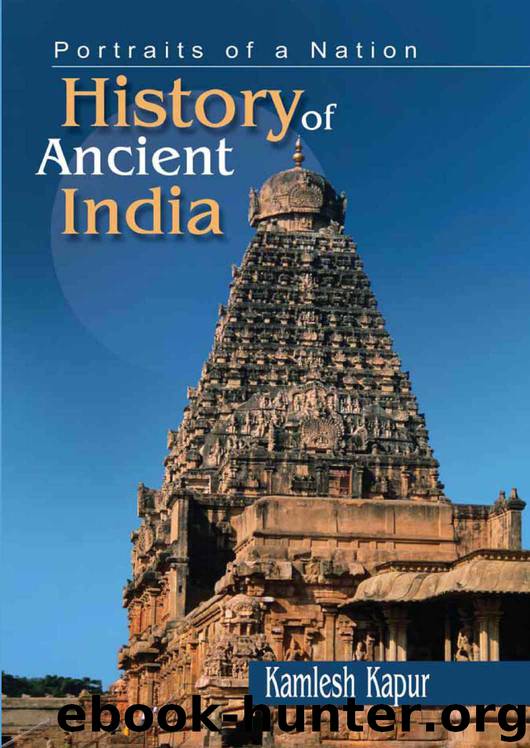
Portraits of a Nation: History of Ancient India by kamlesh kapur
Author:kamlesh kapur [kapur, kamlesh]
Language: eng
Format: azw3, epub
Publisher: Sterling Publisher Private Limited
Published: 2013-11-09T16:00:00+00:00
Iron pillar at Mehrauli “India’s heritage of solving problems is often overshadowed by centuries of colonialism and conquest. Outside Delhi, I visited one of the oldest monuments to that history... pillar of iron alloy, smelted by Indian metallurgists with such skill that it has remained rust-less for 1,500 years. These superb technicians were brethren of Indian thinkers who originated the concepts of zero and infinity and devised the inaccurately named Arabic numeral system, giving the science of mathematics to a world drenched in superstitious ignorance.”
To meet the religious aspirations of the people, the artists started making exquisitely sculptured temples. Mathura and Sarnath were centers of artistic activity. Unfortunately many of these ancient temples were destroyed in the subsequent invasions by Central Asian tribes. Two surviving temples of that period—one at Bhitargaon near Kanpur and another at Deogarh near Jhansi testify to the fine workmanship of the Gupta artists.
Building work on the famous Ellora caves started during this period. Created along historical and religious themes, carved out of rocks, these temples with frescoes, paintings and statues are marvels of architecture.
Credit for Ajanta caves which have marvelously sculptured statues and paintings around Jaina, Hindu and Buddhist themes is also given to the Guptas, even though most of the work was completed by the Rashtrakuta Kings of the Karnataka Kingdom.
Kailasa Temple (rock-cut architecture) The work of such a stupendous nature was started and continued under the patronage of several kings, Guptas and the Rashtrakuta King Krishna I, to name a few. The Hindu caves are dedicated to Lord Shiva. Shiva’s manifestations are many – he is shown as Mahakala or the personification of death and time, as Mahayogi or ascetic, as Nataraja or Lord of the Dance. Many other Devas and aspects of the female energy are also portrayed in the sculptured panels. Vishnu and Brahma are also shown in a variety of forms indicating that all different sects had friendly relations and could opt to worship either of the two or both.
Download
Portraits of a Nation: History of Ancient India by kamlesh kapur.epub
This site does not store any files on its server. We only index and link to content provided by other sites. Please contact the content providers to delete copyright contents if any and email us, we'll remove relevant links or contents immediately.
| Africa | Americas |
| Arctic & Antarctica | Asia |
| Australia & Oceania | Europe |
| Middle East | Russia |
| United States | World |
| Ancient Civilizations | Military |
| Historical Study & Educational Resources |
The Sympathizer by Viet Thanh Nguyen(4447)
The Rape of Nanking by Iris Chang(4265)
World without end by Ken Follett(3512)
Ants Among Elephants by Sujatha Gidla(3495)
Blood and Sand by Alex Von Tunzelmann(3242)
Japanese Design by Patricia J. Graham(3220)
The Queen of Nothing by Holly Black(2660)
City of Djinns: a year in Delhi by William Dalrymple(2581)
India's Ancient Past by R.S. Sharma(2493)
Foreign Devils on the Silk Road: The Search for the Lost Treasures of Central Asia by Peter Hopkirk(2482)
Tokyo by Rob Goss(2468)
Inglorious Empire by Shashi Tharoor(2463)
In Order to Live: A North Korean Girl's Journey to Freedom by Yeonmi Park(2411)
Tokyo Geek's Guide: Manga, Anime, Gaming, Cosplay, Toys, Idols & More - The Ultimate Guide to Japan's Otaku Culture by Simone Gianni(2400)
India's biggest cover-up by Dhar Anuj(2381)
The Great Game: On Secret Service in High Asia by Peter Hopkirk(2375)
Goodbye Madame Butterfly(2289)
Batik by Rudolf Smend(2213)
Living Silence in Burma by Christina Fink(2093)
